

“My tests came back normal, but I still have symptoms.” This can leave both patients and clinicians with difficult questions. Does it mean nothing is wrong, or that a test missed the problem? Neither conclusion follows automatically. Understanding the limits of testing helps make the follow-up conversation more useful.
Figure 01 · The whole picture
The lab report is one part of care
Onset, severity, and impact on daily life
Health, treatments, and previous results
Findings from the clinical assessment
Method, limitations, and the question being investigated
The next step depends on how these pieces fit.
What “within the reference range” means
For many quantitative tests, the reference interval covers the central 95% of results in a population selected using defined criteria. In this model, about 5% of results in that population fall outside the interval. This does not, by itself, determine who is healthy or ill. [2]
Figure 02 · Understanding the interval
A range for comparison, not a diagnosis
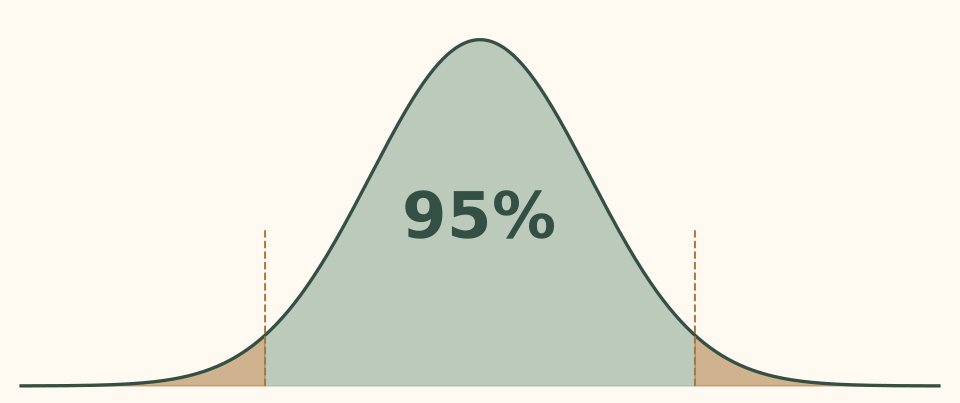
The method, age group, and reference population can affect the appropriate interval. A result needs clinical context; it is not a universal boundary between health and disease. [2]
Figure 03 · Distinguishing concepts
Three numbers can serve three different purposes
Reference interval
Compares a result with a reference population.
Where does this result fall?Decision threshold
Helps guide a defined clinical decision.
What decision does this threshold inform?Treatment target
Applies when there is a clinical indication and relevant evidence.
Is there a target that applies to me?Why ordering more tests does not always bring clarity
There is a familiar statistical pitfall: testing more things at once can increase the chance of finding at least one result outside its interval by chance, even without an underlying disease. [2] This does not make testing unnecessary. It means that ordering “everything” is rarely a shortcut to an answer.
Figure 04 · Seeing the logic
More results can also bring more uncertainty

The chance that at least one result falls outside the interval, not the chance of having a disease.
View the calculation and values
Model: 1 − 0.95n. This assumes independent tests, each with a 5% chance of an out-of-range result in the reference population.
| Tests | At least one result outside the interval |
|---|---|
| 1 | 5.0% |
| 10 | 40.1% |
| 20 | 64.2% |
A test changes the probability of a clinical hypothesis. Results differ in how strongly they help confirm or rule out a condition. A test's usefulness depends on the question it is meant to answer. [3]
Why symptoms can persist despite these results
Persistent symptoms occur in different conditions, including when available tests do not yet explain the problem. Toussaint and colleagues call for recognizing this burden, reducing stigma, and integrating biological, psychological, and social context into care. Their paper proposes an approach; it does not establish the cause of an individual's symptoms. [4]
A result within its reference interval and a real symptom can coexist. Dismissing the symptom without assessing the wider context is as unhelpful as relying only on repeated tests.
The contribution of the clinical history
Figure 05 · Following changes over time
Your history has a timeline
- BeforeWhat were your usual health and daily routine like?
- At the startWhen did the symptom first appear?
- Since thenWhat changed, improved, or worsened?
- TodayHow does it affect your life?
What the 1975 study found—and its limitations
A classic study published in the British Medical Journal in 1975 followed 80 new medical outpatients. It compared diagnoses recorded after the referral letter, the history, and the physical examination with the diagnosis accepted two months later. The eventual diagnosis had already been reached after the letter and history in 66 of the 80 cases. Physical examination contributed the diagnosis in seven, and laboratory investigation in another seven. [1]
This was a small study in an outpatient setting with the resources of another era. It does not measure today's clinical performance or establish a universal percentage of diagnoses made by taking a history. It illustrates the contribution of the clinical conversation without dispensing with examination or indicated testing.
Three questions to organize the next step
Figure 06 · The follow-up conversation
Three questions to guide the discussion
- 01
What has changed?
Explain when it began, how it developed, and what it now limits.
- 02
What question was the test addressing?
Discuss what that test can help clarify.
- 03
How was the sample collected?
Review timing, preparation, medicines, and supplements.
At the appointment, review changes in the problem, the question behind the test, and the conditions of sample collection. Repeating a test may help when there is a clinical reason; no single schedule resolves every situation. [5]
When to seek assessment sooner
Urgency depends on the symptom and how it changes. A previous result within its interval should not delay care when an important new change occurs. The examples below are not a complete list.
What this article explains—and what it cannot establish
It explains the limits of an isolated result and helps organize a follow-up conversation. It cannot determine the cause of your symptoms, whether you need more tests, or the appropriate timing of your follow-up.
Figure 07 · Preparing for the appointment
Four things to bring with you
Dated test reports
Include previous results you already have.
Medicines and supplements
Bring a list of what you are taking.
A symptom record
Note when symptoms occur and what seems to affect them.
Questions and changes
Explain what has changed and ask when to seek earlier review.
Explore related topics
For an example of how concurrent symptoms are organized in an assessment, read When several symptoms appear together: how is the investigation organized? For the meaning and limitations of specific markers, visit Understanding lab tests.
References and evidence
References were checked for their identity and the available scope. The publication type is stated alongside each reference; on its own, that label is not a formal certainty-of-evidence rating.
- [1] Hampton JR, Harrison MJ, Mitchell JR, Prichard JS, Seymour C. Relative contributions of history-taking, physical examination, and laboratory investigation to diagnosis and management of medical outpatients. Br Med J. 1975;2(5969):486-9. doi:10.1136/bmj.2.5969.486 small observational study · historical
- [2] Timbrell NE. The Role and Limitations of the Reference Interval Within Clinical Chemistry and Its Reliability for Disease Detection. Br J Biomed Sci. 2024;81:12339. doi:10.3389/bjbs.2024.12339 narrative review
- [3] Grimes DA, Schulz KF. Refining clinical diagnosis with likelihood ratios. Lancet. 2005;365(9469):1500-5. doi:10.1016/S0140-6736(05)66422-7 methodological article
- [4] Toussaint A, Weigel A, Löwe B. The overlooked burden of persistent physical symptoms: a call for action in European healthcare. Lancet Reg Health Eur. 2025;48:101140. Published online November 26, 2024; January 2025 collection. doi:10.1016/j.lanepe.2024.101140 position paper · not a clinical trial
- [5] U.S. National Library of Medicine. How to Understand Your Lab Results. institutional educational guidance
- [6] MedlinePlus Medical Encyclopedia. Recognizing medical emergencies. safety guidance
If this is your situation, discuss what has changed since your last tests with the professional who follows your care.